Emery Blagdon
1907 - 1986
Emery Blagdon (American, 1907 – 1986) was compelled for reasons only known to himself to construct a massive environment housed in a shed near Stapleton, NE. The shed was a simple affair with an outer work room, and then behind locked doors, a larger room. Here he hung, stacked and suspended simple to complex sculptures made of copper wire, nails, aluminum foil, tractor gears, all, he believed charged with electromagnetism with regenerative, healing powers. He called these creations healing machines or his pretties, both as individual units and as a magnum opus. Accompanying the machines were his enamel paintings on board that he sometimes embellished with strips of aluminum foil, nails, and bits of glitter. These were usually stacked under the machines, often with the painted surface facing the ground. Vaguely resembling circuit boards, some observers have speculated their purpose, given their location in the shed, was to boost the electromagnetic charge of the machines, that charge driving the healing capacity of Blagdon’s creations. Along with the perpetual wind from the nearby Sand Hills, light entered the shed through the chinks in the walls, so Blagdon, already convinced of his innate connection to electromagnetism was comfortable pulling electricity from his home into the shed so it could be lit with strands of Christmas tree lights strung throughout, sometimes placing the lights in glass jars that enhanced their glow.
The machines varied broadly in size, shape, and composition. Often comprised of assembled discreet parts, the sculptures hung from the rafters of the shed or on nails on the walls. Others, a few, were placed on plinths in the shed.
Fortuitously, after Blagdon’s passing the contents of the shed were saved down to the floorboards. The majority of the shed is on permanent view at the Art Preserve, at John Michael Kohler Arts Center in Sheboygan, WI. Significant examples are also in the Smithsonian Museum of American Art, Washington, D.C., The Museum of Everything, UK, and the Pompidou Center, Paris.
Three of the free-standing works in the shed were rocket ships. One is now in the Pompidou collection, one is at the Arts Preserve, and the third was recently added to my collection. Long in the possession of Don Christensen, who, along with Dan Dryden was instrumental in saving the contents of Blagdon’s shed, Christensen recently cleaned the complex sculpture. It is composed of hundreds of pieces of thin wooden slats, most of which are carefully wrapped in copper wire, and then further wrapped in aluminum foil. In between the multiple layers that compose what Christensen calls the Bird Rocketship are just visible brightly colored papers salvaged from grocery store advertisements for fruits and vegetables, opened cereal boxes, and random sheets of repurposed plastic fertilizer bags. The lean architectural structure of the rocket ship is offset by the gleam of copper wire and the shine of aluminum foil. Throughout the sculpture Blagdon tucked small squares of layered paper, aluminum foil and copper wire. Slightly hidden from view, they evoke small talismanic books adding further mystery to his creation. - Bio provided by Shari Cavin at Cavin-Morris Gallery
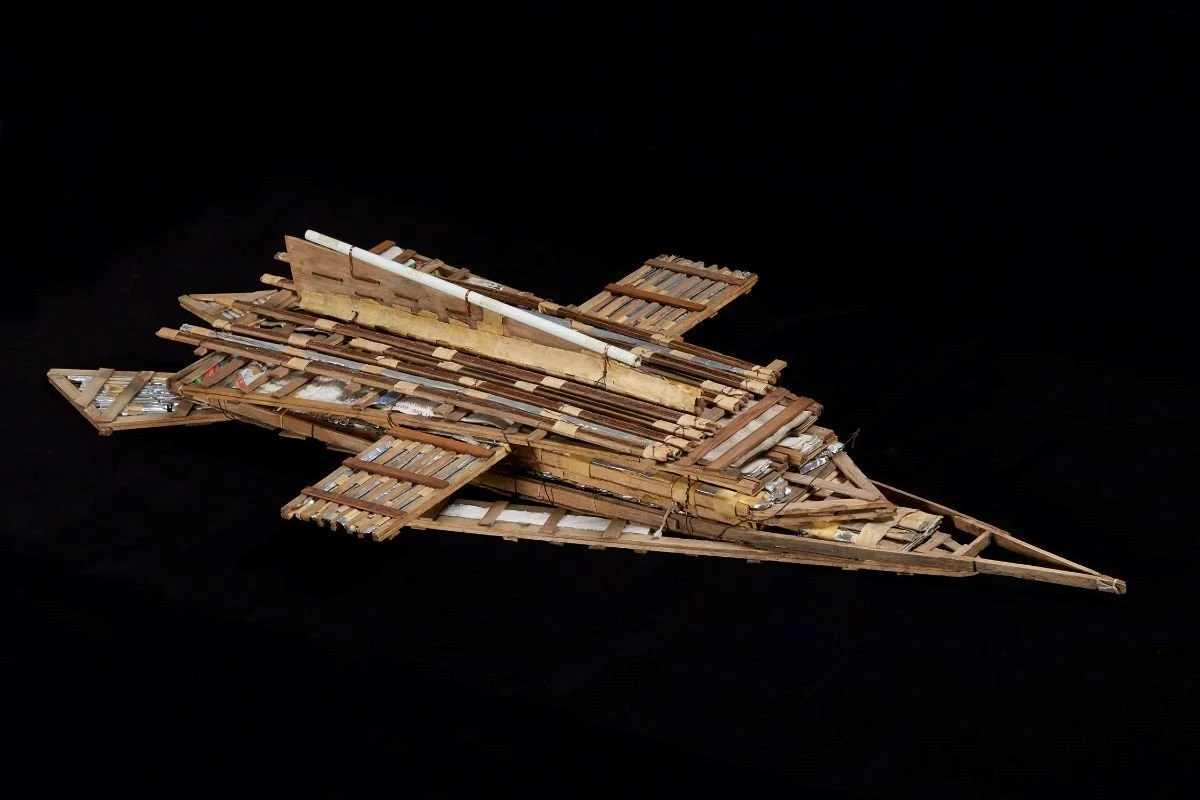
Machine #351, c. 1954-1986, Aluminum foil, copper wire, steel wire, paper, cereal box cardboard, masking tape, polyethylene plastic (recycled seed bags), wood and magnets - 48 x 24 x 8 inches
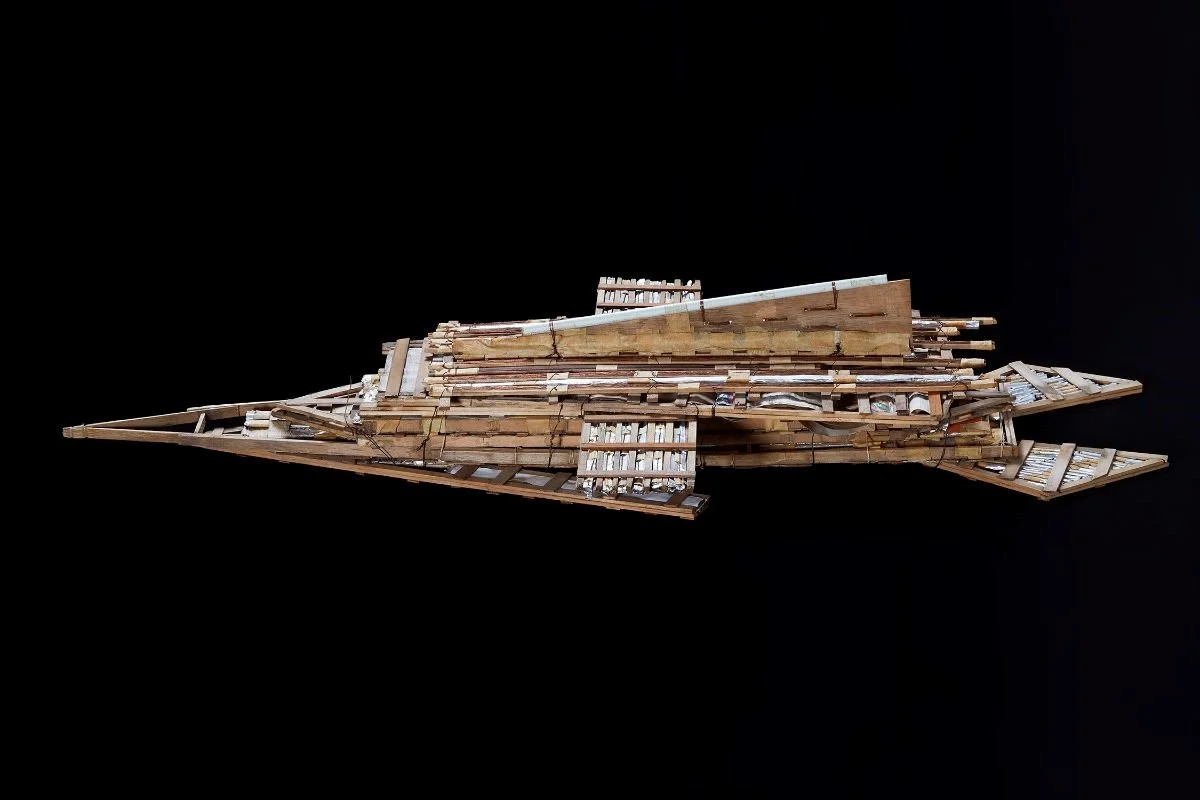
Machine #351 - side view
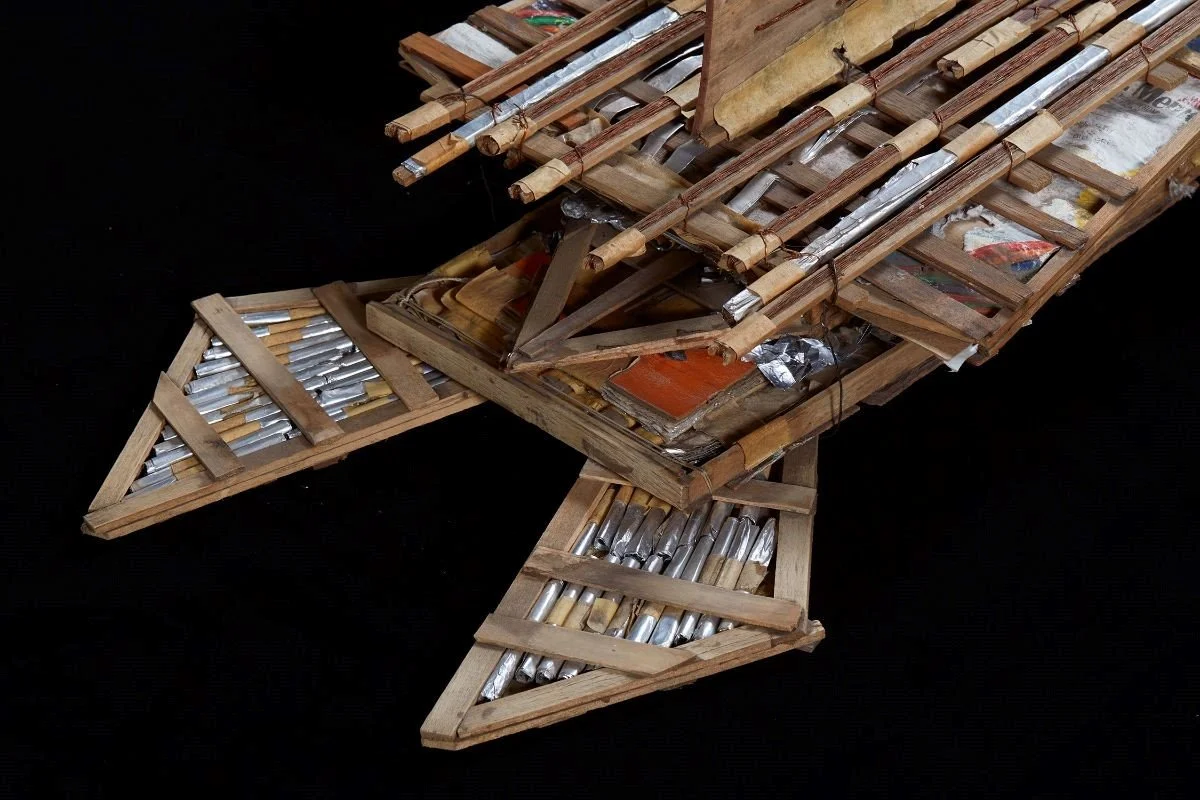
Machine #351 - back view